
Retirement Planning Edition Episode 9 - Retirement Distribution: Solving the 4% Rule vs. Buckets Dilemma
YouTube
(click on the image to watch the video)
Resources
Show Notes
Retirement Distribution: Solving the 4% Rule vs. Buckets Dilemma - Show Notes
Integrating Math and Psychology for a Safe, Simple, and Sound Retirement
Quick Episode Summary
In this episode, we tackle the fundamental tension in retirement planning: the battle between rigid mathematical rules and the human need for safety. We explore why the industry often forces retirees to choose between the "Sound" logic of the 4% Rule and the "Safe" psychology of the Bucket Approach. By applying the SafeSimpleSound (S3) methodology, we dismantle this false binary and present a "Both/And" distribution strategy that integrates mathematical discipline with behavioral guardrails, ensuring you can survive market volatility without panic.
SafeSimpleSound Framework Featured
- Primary Principle: Integration Over Abandonment. Rather than discarding the 4% rule because it lacks empathy, or abandoning growth for safety, we integrate opposing strategies to create a resilient whole.
- S3 Characteristic Emphasis:
- Safe: Prioritizing psychological safety and protection against panic selling during market downturns.
- Simple: Creating visual clarity on where your "grocery money" is coming from for the next two years.
- Sound: Using historical data (4% rule) as a governor to ensure long-term sustainability.
- Contradiction Resolved: The dilemma between Growth Potential (requiring risk/volatility) and Income Stability (requiring safety/cash) is resolved through Time-Segmentation.
Who This Episode Serves
- Pre-Retirees (The "Climbers"): Individuals within five years of retirement feeling the anxiety of transitioning from accumulation to distribution.
- Current Retirees: Those currently drawing income who feel exposed to market volatility or unsure if their withdrawal rate is sustainable.
- Families Seeking Clarity: Investors confused by the binary arguments between "total return" advocates and "safety-first" proponents in financial media.
What You'll Learn
- Harmonize Math and Emotion: How to use the 4% rule as a "governor" for total spending while using Buckets as the "transmission" for sourcing that cash.
- Eliminate Panic Selling: How to structure a portfolio that allows you to leave depressed assets alone during a market correction.
- Create a Self-Healing Portfolio: Learn the mechanical logic of refilling your cash buckets based on market performance (skimming the cream vs. consuming reserves).
- Align Income with dignity: Why essential expenses must be covered by guaranteed income or cash reserves, while discretionary spending can be linked to market performance.
Key Topics & Concepts
Primary Focus: The S3 "Both/And" Distribution Strategy — An integrated approach to retirement income that mitigates Sequence of Returns Risk.
Concepts Covered:
- The 4% Rule: A "Sound" academic guideline suggesting a safe initial withdrawal rate adjusted for inflation, historically ensuring a 30-year portfolio survival.
- The Bucket Approach (Time-Segmentation): A "Safe" psychological strategy dividing assets based on when the money will be needed (Now, Soon, Later).
- Sequence of Returns Risk: The danger of experiencing negative market returns early in retirement while simultaneously withdrawing funds, permanently impairing the portfolio.
- Behavioral Guardrails: Structures designed to protect investors from their own emotional reactions to short-term market noise.
- Integration Over Abandonment: The S3 principle of combining the best elements of opposing strategies rather than choosing one.
Professional Authority Elements:
The episode demonstrates deep expertise in Behavioral Finance, acknowledging that the "greatest enemy of the retiree is panic." It moves beyond spreadsheet logic to address the physical reality of selling assets at a loss.
Stakeholder Value Creation:
This framework serves the client by reducing anxiety, the family by securing essential needs, and the practitioner by providing a logical, defensible methodology for income generation.
Episode Breakdown
Opening: The Landscape of Confusion
- The Two Camps: The financial industry is often divided into the "4% Rule" advocates (Data/History) and the "Bucket Approach" champions (Safety/Psychology).
- The Constitutional Challenge: Retirees are forced into a false choice: rigid math that ignores emotion, or complex accounting that lacks a spending governor.
- S3 Establishment: We must "slow down, think constitutionally, and build a plan that is Safe, Simple, and Sound."
The Fatal Flaw of the 4% Rule
Insights:
- The 4% rule is "Sound" but assumes the investor is a robot.
- It requires selling stocks during a downturn to meet cash needs, which feels like "locking in a loss."
- Selling depressed assets violates the "Safe" principle by digging a hole that is mathematically difficult to escape (Sequence of Returns Risk).
The S3 Solution: Integration
Process/Framework/Steps:
- Bucket 1 (Now): Cash and equivalents for years 1-2. Job: To be there. (Boring money).
- Bucket 2 (Soon): Bonds and stable income for years 3-10. Job: The bridge/stability.
- Bucket 3 (Later): Growth stocks for year 10+. Job: The engine/fighting inflation.
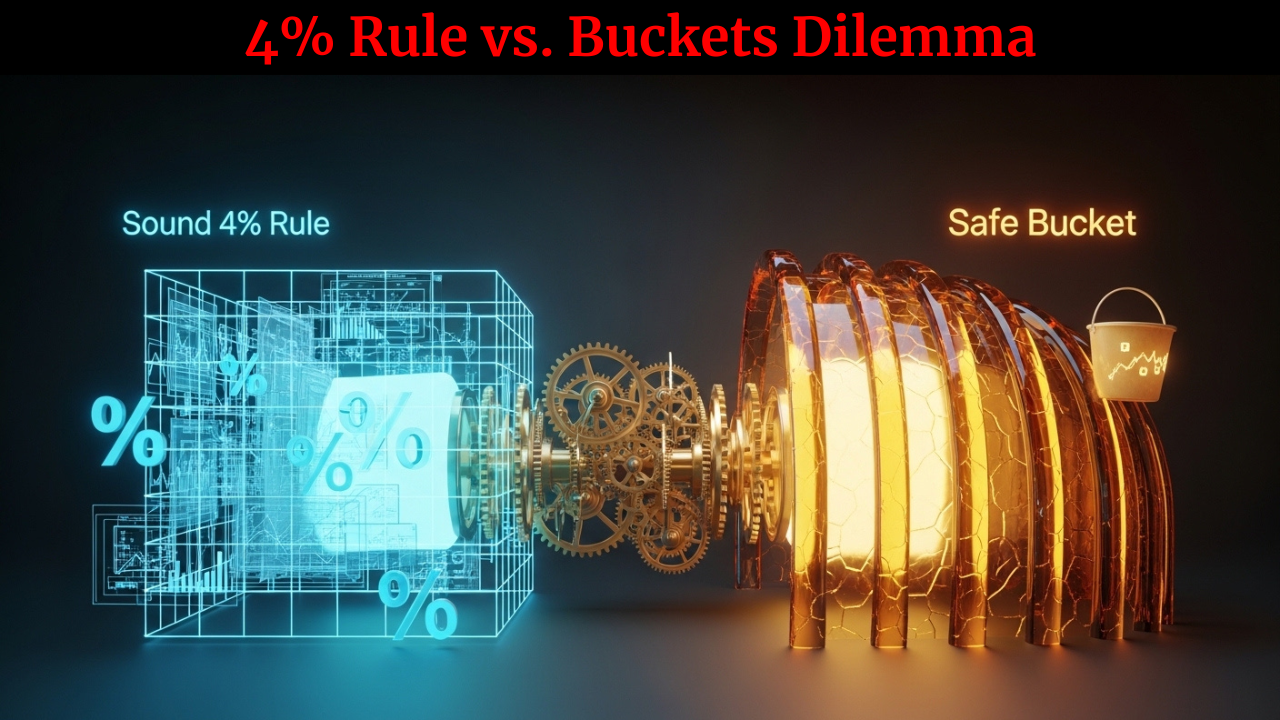
- The Integration: Use the 4% rule to determine how much to spend (the Governor), but use the Buckets to determine where to pull it from (the Transmission).
Case Study: Arthur and Martha
Insights:
- Scenario: A couple retires with $1M, needing $40k/year. The market drops 20% in first 6 months.
- Without S3: They panic, see their net worth drop, sell depressed assets to pay bills, and eventually move to cash, locking in losses.
- With S3: They see the drop in Bucket 3 (Later), but Bucket 1 (Now) is intact. They spend from cash, buying patience for their stocks to recover. Behavior dictates the outcome.
Mechanics: The Self-Healing System
Practical Applications:
- In Up Markets: Skim profits ("the cream") from Bucket 3 to refill Bucket 1. Secure the gains.
- In Down Markets: Leave Bucket 3 alone. Spend down Bucket 1 reserves. If needed, tap Bucket 2.
- Expense Matching: Align Essential Expenses (Housing, Food) with Guaranteed Income/Bucket 1. Align Discretionary Expenses (Travel) with Bucket 3 performance.
Closing: The Psychology of Clarity
- Key Takeaway: Panic comes from ambiguity. Simplicity provides the visual clarity needed to stay the course.
- Vision: Moving from a "black box" algorithm to a visible plan where you can point to the money intended for specific years.
Practical Resources
Self-Reflection Questions
- The "Safe" Check: If the market dropped 30% tomorrow, do I know exactly which dollars I am spending next month, or would I have to sell a mutual fund?
- The "Sound" Check: Is my current withdrawal rate sustainable based on history (around 4%), or is it too high?
- The Clarity Check: Can I point to a specific part of my portfolio and say, "That is my money for 2030"?
Examples & Scenarios
[The Arthur & Martha Scenario]
- Situation: Retired with $1M portfolio, needing $40k/year.
- Challenge: Market correction of 20% early in retirement.
- Solution (S3): They had $80k (2 years of expenses) in Bucket 1 Cash.
- Key Takeaway: While their net worth dropped on paper, their lifestyle was secure. They did not sell a single share of stock to buy groceries. The structure bought them the patience to wait for a recovery.
Implementation Guide
If you want to apply these constitutional insights:
Step 1: Determine Burn Rate (Soundness)
Calculate exactly how much you need from your portfolio annually. Ensure it is sustainable (ideally near 4%).
Step 2: Calculate Safe Runway (Safety)
Multiply your annual portfolio need by two. This amount should be moved to Bucket 1 (Cash/Money Market).
Step 3: Map the Timeline (Simplicity)
Allocate remaining funds: Fixed income/bonds for the next 7-8 years (Bucket 2), and growth assets for 10+ years out (Bucket 3).
Resources & Tools Mentioned
- The S3 Time-Segmented Bucket Planner: A downloadable PDF implementation tool mentioned in the episode (available at SafeSimpleSound.com) to help map current assets into Now, Soon, and Later buckets.
Key Quotes & Insights
"The financial industry often presents this as a binary choice. You either follow a strict rule, or you build a complex web of accounts. Today... we are going to dismantle that false choice."
"Simplicity isn't just about having fewer accounts; it's about having clarity on what the money is for."
"When you sell a depressed asset to buy groceries, you are permanently impairing your portfolio's ability to recover. You are digging a hole that gets harder and harder to climb out of."
"We use the 4% rule to determine how much we can safely spend in total. It acts as the governor on the engine. But we use the Buckets to determine where that money comes from. It acts as the transmission."
Professional Authority
S3 Methodology Demonstrated
- Safe Foundation: The strategy prioritizes the "sleep factor" (psychological safety) by ensuring essential needs are never dependent on daily market performance.
- Simple Application: It transforms a complex "messy pile" of funds into three clear, distinct time horizons that any client can understand visually.
- Sound Strategy: It respects the math of the 4% rule and the necessity of equity growth to fight inflation over a 30-year period.
Competitive Advantages
- Behavioral focus: Unlike robo-advisors or pure math models, S3 explicitly accounts for human emotion (fear/panic) as a critical variable in financial success.
- Both/And Thinking: Rejects the industry's tendency toward "Either/Or" dogmas, proving that you can have the safety of cash and the growth of stocks simultaneously through time-segmentation.
Educational Generosity Evidence
- The episode provides the specific logic (4% rule + Buckets), the implementation steps (Burn Rate calculation), and a free tool (Bucket Planner) regardless of whether the listener becomes a client.
Additional Learning
Related Topics
- Sequence of Returns Risk: Deepen your understanding of why early losses are so destructive.
- Inflation Protection: Why "Safe" investments (Cash) are actually risky over the long term (Bucket 3 necessity).
- Essential vs. Discretionary Budgeting: How to categorize expenses to match income sources.
Development Pathway
- Next Concept: Moving from Distribution planning to Legacy planning (what happens to Bucket 3 if you never spend it?).
- Advanced Application: Tax-efficient bucket filling (Asset Location strategies alongside Asset Allocation).
Connect & Continue the Conversation
Connect with SafeSimpleSound
- Website: www.SafeSimpleSound.com
- Services: Retirement Income Planning, Wealth Management, S3 Framework Implementation.
- Email: hello@safesimplesound.com
- Social Media: https://www.linkedin.com/in/phanikandula/
Listener Engagement
We'd love to hear about your journey:
- When you look at your current portfolio, does it look like "one big pile" or distinct timelines?
- Have you ever experienced the "knot in your stomach" of selling an investment when the market was down?
- How would having 2 years of cash "on the shelf" change your anxiety level regarding the stock market headlines?
Professional Services
SafeSimpleSound helps families build plans that are resilient enough to handle the market and clear enough to provide peace of mind. We specialize in transforming "accumulators" into "distributors" by implementing the S3 Time-Segmented framework, ensuring you never have to choose between mathematical soundness and psychological safety.
DISCLAIMER: This content is for educational purposes only and should not be considered personalized financial advice. Always consult with a qualified financial professional before making financial decisions.